
Career & Technical Education (Perkins V)
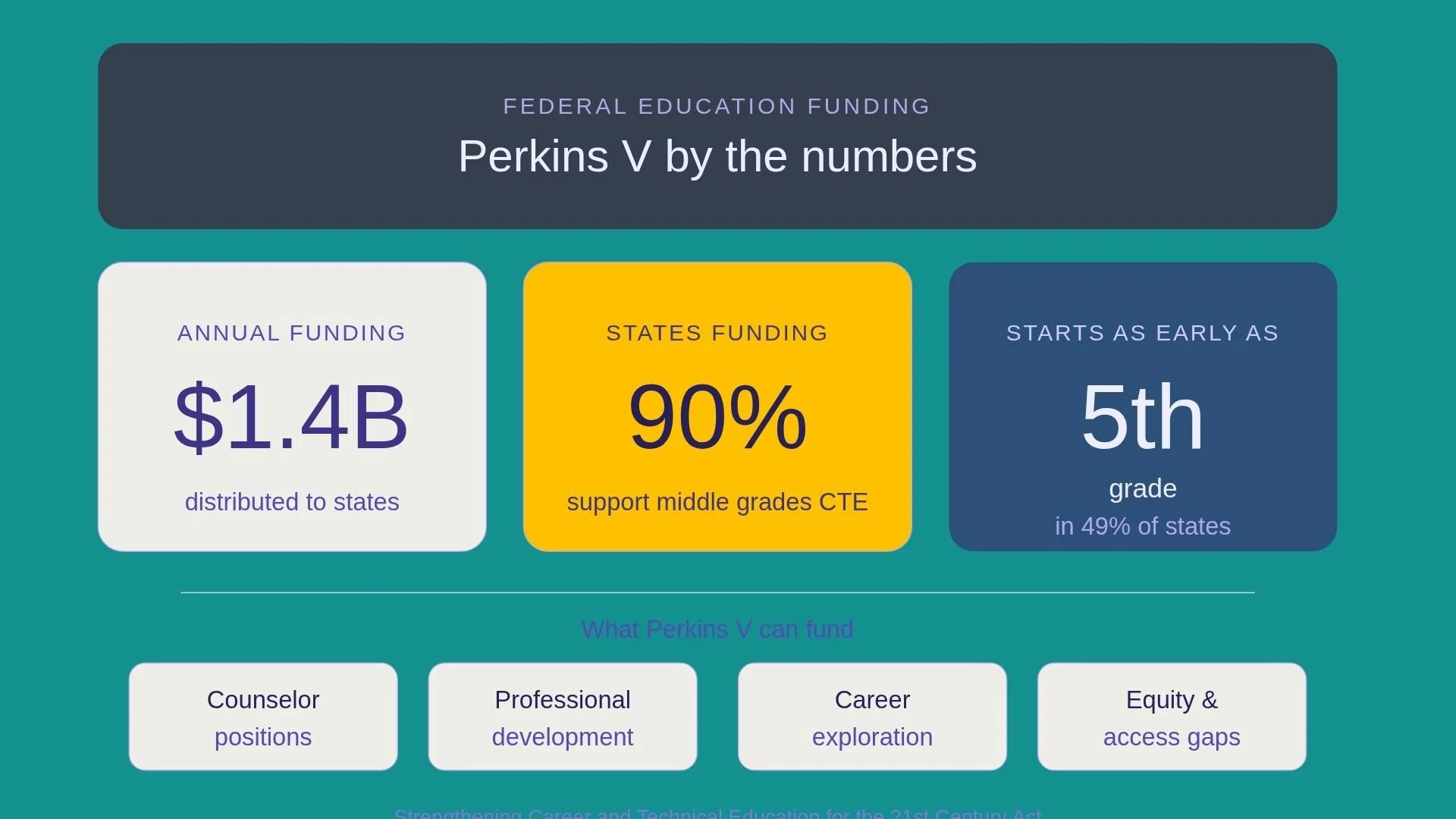
The Strengthening Career and Technical Education for the 21st Century Act (Perkins V) is a major federal law that provides approximately $1.4 billion annually to support career and technical education (CTE) programs across the United States.
Perkins V funding is managed by the federal government at the state level, meaning deadlines for school districts vary significantly by state. While federal law sets the overarching guidelines, individual states establish their own calendars for Perkins V applications, reporting, and renewals. Most states operate on a fiscal year starting July 1, with application cycles occurring in late winter and spring.
Core Objectives of Perkins V
Perkins V aims to develop the academic, technical, and employability skills of students through high-quality programs of study.
Programs of Study: It prioritizes a non-duplicative, coordinated sequence of courses that link secondary and postsecondary education and lead to recognized credentials.
Labor Market Alignment: Funding must support programs aligned with high-skill, high-wage, or in-demand occupations.
Focus on Equity: The law requires states to prioritize the performance of "special populations," including English learners, individuals with disabilities, and foster youth.
Typical State Allowable Uses of Funds
Career Exploration: Providing guidance and counseling on career and postsecondary options as early as 5th grade in many states.
Professional Development: Training for teachers, faculty, administrators, and school counselors.
Skills Development: Ensuring students acquire the technical and academic skills necessary for their field.
Program Implementation: Developing, coordinating, and improving CTE programs.
Performance Assessment: Monitoring student performance and accountability indicators.
Closing Gaps: Implementing activities to improve access and equity for underserved student groups.
Perkins V in 5th Grade (NEW)
Under the Strengthening Career and Technical Education for the 21st Century Act (Perkins V), federal funds can now be used for students as young as fifth grade.
This represents a significant change from the previous version of the law (Perkins IV), which generally limited funding to students in the "middle grades" (defined as starting in seventh grade) and above.
Key Details on Grade-Level Usage
State Flexibility: While federal law allows funding to start in the 5th grade, individual states have the flexibility to decide exactly which grade levels they will support within their own plans.
Adoption Rates: Approximately 90% of states formally allow Perkins V funds to support middle grades (typically grades 5-8) for career exploration and technical education initiatives.
Common Grade Ranges: About half of all states (49%) specifically report allowing the use of these funds starting in grade 5.
Focus Areas: For these lower grade levels, funds are primarily used for career exploration and introducing students to various career pathways before they reach high school.
The primary national clearinghouse for this information is the Perkins Collaborative Resource Network (PCRN), managed by the U.S. Department of Education.
You can use their Perkins State Plans and Data Explorer to access the specific plans for every state and territory
Funding School Counseling Positions and Professional Development
Depending on your state, Perkins V can provide funding for both school counselor positions and professional development, provided the roles and activities are directly tied to Career and Technical Education (CTE) programs.
1. Funding for Counselor Positions
Perkins V funds can be used to pay for the salaries and benefits of career guidance and academic counselors, but with specific restrictions:
CTE Focus: The counselor's primary role must be to provide information on postsecondary education and career options specifically for students enrolled in qualified CTE programs.
Supplement, Not Supplant: Federal funds cannot be used to pay for counselor positions that were previously funded by state or local dollars. They must be used to provide "something extra" rather than day-to-day operational costs.
Proportional Funding: If a counselor serves both CTE and non-CTE students, Perkins funds can typically only cover the portion of their salary dedicated to CTE-specific activities.
2. Professional Development
Professional development is a required use of funds under Section 135 of the Act. Eligible recipients must provide training for personnel, including career guidance and academic counselors, that focuses on:
Industry Knowledge: Advancing skills and understanding of all aspects of an industry, including the latest workplace technologies and standards.
Career Exploration: Developing systematic frameworks for career exploration and informed decision-making for students.
Integration: Learning how to better integrate academic and technical standards into CTE curriculum.
Important Constraints
Comprehensive Local Needs Assessment (CLNA): All expenditures, including staffing and training, must be directly justified by the results of the local needs assessment.
Administrative Cap: In most states, no more than 5% of the local award may be used for administrative purposes, which may limit how certain support roles are classified. Check with your state plan.
Federal Reporting Deadlines
State agencies must meet these federal milestones to receive and distribute funds to local districts:
State Plan Revisions/Budgets (FY 2026): States must submit revisions to the Perkins State Plan Portal by May 9, 2025.
Consolidated Annual Report (CAR): For the 2024-2025 program year, the state-level performance report is due by January 31, 2026.
For most states, the State CTE Director serves as the primary Perkins V Coordinator or oversees the team responsible for Perkins administration. For a full list of all 50 states, DC, and territories, please visit the Advance CTE State Directors directory and the US Dept of Education staff contact page.
How to Use This List
Federal Verification: You can verify current Regional Perkins Coordinators through the official website hosted by the U.S. Department of Education at: Perkins Collaborative Resource Network (PCRN).
Local Application: If you are a school district official, your primary contact for grant technical assistance is typically a Regional Education Service Center or the state-level Education Programs Consultant listed on your specific Department of Education website.
