
School Counselors as Leaders in CYBHI
Introduction: Meeting the Moment in California’s Schools
California is at a meaningful turning point for student behavioral health. For many years, the distance between school life and essential mental health care has made it difficult for students to get the support they deserve.
The Children and Youth Behavioral Health Initiative (CYBHI) is a sincere effort to bridge this gap through a statewide school-linked fee schedule. This isn't just a policy update; it's an invitation to work together to ensure that mental health and substance use support is available whenever and wherever students feel most comfortable seeking it.
As a Pupil Personnel Services (PPS) credentialed practitioner, your role is more than professional—it is deeply personal. Your care and dedication are what will truly bring the CYBHI vision to life for children across California.
Transforming Student Access: The Moral and Operational Imperative
The CYBHI multi-payer approach is a paradigm shift for student equity. By mandating participation from Medi-Cal (Managed Care and Fee-for-Service), commercial insurers, and disability health care service plans, the state has neutralized the "insurance lottery" that previously dictated a student’s level of care.
The immediate benefits to your students and their families are profound:
Zero Out-of-Pocket Costs: Services are rendered with no deductibles and no financial burden on the family.
Comprehensive Coverage: The program integrates seamlessly with existing insurance, ensuring that school-based care does not negatively impact a family’s private coverage limits.
Age-Appropriate Scope: Eligibility extends to youth under age 26, specifically those enrolled in public TK-12 schools and public institutions of higher education.
This framework effectively de-risks the help-seeking process for families, allowing school counselors to build a wellness culture where care is integrated into the school’s operational fabric.
The "New Revenue" Reality: Securing Sustainable School Funding
The traditional "funding cliff" of grant-based mental health programs is the greatest threat to institutional stability. The CYBHI Fee Schedule solves this by establishing a permanent, recurring reimbursement pathway. This shift transforms the school counselor from a "cost center" into a "sustainability lead" who generates the very revenue that helps secure their position.
The program’s momentum is already reflected in the statewide data:
CYBHI Impact by the Numbers (as of March 2026)
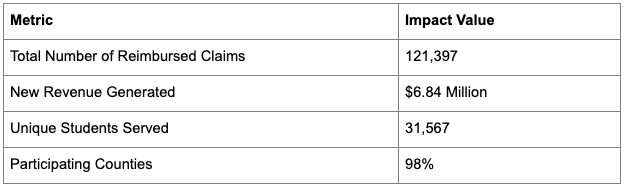
These funds should be strategically reinvested into your school’s service delivery and billing infrastructure, and have the potential over time to eliminate the "funding anxiety" that has historically plagued school counseling roles.
Ethical Implementation: Prioritizing a Needs-First Approach
While the CYBHI Fee Schedule secures a pathway to permanent funding, school counselors must ensure ethical, student-centered implementation. The core risk is adopting a "revenue-first mentality"—starting with a financial target (e.g., "$5M/year") and attempting to force existing services to fit billable codes, creating a problematic "cart before the horse" scenario.
This approach leads to serious risks:
Financial and Ethical Liability: Unethical billing practices, particularly those prioritizing revenue over genuine service, will be identified and penalized during insurance audits.
Diluted Services and Narrowing of Practice: A singular focus on maximizing revenue can lead to hiring lower-cost, non-credentialed staff (like Certified Wellness Coaches) over qualified school counselors or other credentialed professionals, which risks hurting student outcomes. This pressure can also narrow a school counselor's practice, pulling them away from vital academic and college/career supports.
The responsible path forward is to commit to a needs-first model:
Assess Student Needs: Use data to identify the true behavioral health and support needs of your student population.
Develop Program: Create a comprehensive Multi-Tiered, Multi-Domain System of Support (MTMDSS) plan to address those needs holistically.
Map to Billing: Only then should you crosswalk the essential, already-planned services to the CYBHI fee schedule for reimbursement.
Establish Systems for Sustainability: Implement the necessary administrative and data systems to support both preventative, universal services for all students and targeted, data-driven identification for those requiring more intensive support.
This needs-first model ensures that billing is a mechanism for sustainability, enhancing your comprehensive role rather than replacing it, and safeguards your professional integrity.
5. Navigating the Participation Models: Flexibility for Every District
Administrative complexity is no longer a valid excuse for non-participation. The CYBHI program offers two distinct pathways tailored to the varying capacities of school districts.
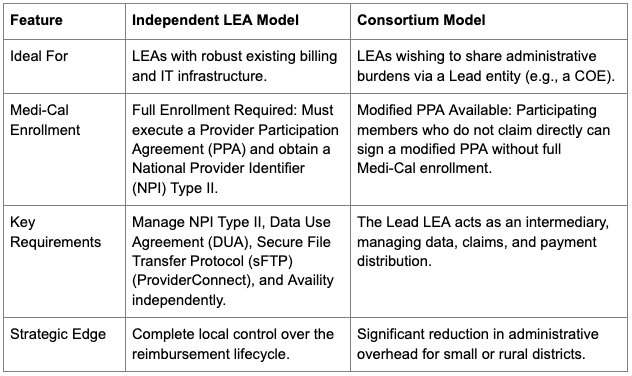
The Lead LEA in a consortium manages the heavy lifting, including student batch registration and file submissions. This provides a clear path for LEAs that do not plan to enroll in Medi-Cal but still want to provide reimbursed care to their students.
6. Expanding the Network: Integrating Community-Based Partners
School counselors are the anchors of a broader "continuum of care." By leveraging the designated provider and practitioner network, school counselors can extend their reach through community partners who are reimbursed via the same Fee Schedule.
There are three strategic pathways for integration:
Embedded Providers: Contracted practitioners functioning on behalf of the LEA can commence claiming for services for up to 120 dayswhile their screening/credentialing is in progress, allowing for immediate implementation.
Affiliated Providers (ANCP): Referral partners with no formal financial relationship must be added to your Standard Provider Import (SPI) Roster using the "ANCP" (Affiliated, Non-Contracted Providers) code. They claim directly as the billing provider, but are linked to your district to track outcomes.
Statewide Affiliated Providers: High-volume partners that serve students regardless of your LEA’s cohort status. To qualify, these providers must serve 10 or more LEAs across at least two counties and cannot be tied to a single fixed location.
This ecosystem allows school counselors to surround students with a wide range of services that no single school could provide on its own. Utilizing the SPI Roster to designate these partners ensures that the student is supported by a seamless network of practitioners, all operating under the same fiscal and ethical standards.
7. Conclusion: A Call to Action for PPS Professionals
As a school counselor, you are the heart of the CYBHI framework. With the February 27, 2026, announcement of Cohort 6, we are entering a new chapter in how we support student wellness together. We encourage you to explore how your LEA can participate in an active cohort, helping to ensure that every student in California has access to these vital services. Joining the CYBHI Fee Schedule is more than just a financial decision; it is a commitment to our students' well-being and a way to provide the compassionate, equitable care that helps every young person truly thrive.
Need a thought partner throughout this process or application-based training specific to your district’s context? We have had the privilege of partnering with 91 California school districts over the past three years and look forward to extending that support to you.
🔗 Partner with Hatching Results!
