
From Good Intentions to Better Outcomes: Using PDSA to Continuously Improve Student Support
Schools are filled with dedicated professionals working tirelessly to support students, yet well-intentioned effort alone does not guarantee meaningful impact.
Consider a few familiar scenarios:
A school counselor facilitates the same attendance group each semester out of routine.
A student support team refers struggling students to tutoring without first diagnosing the root cause of academic failure.
A school implements a behavior intervention, sees modest gains, and maintains it indefinitely - never evaluating which students truly benefit, whether implementation remains faithful, or if a more effective alternative exists.
These scenarios do not stem from a lack of commitment, but from a systemic reality in education: the urge to react swiftly often eclipses the crucial step of verifying whether we are addressing the right problem, implementing the best strategy, and systematically measuring results.
This critical gap is precisely where the Plan-Do-Study-Act (PDSA) framework provides transformative value.
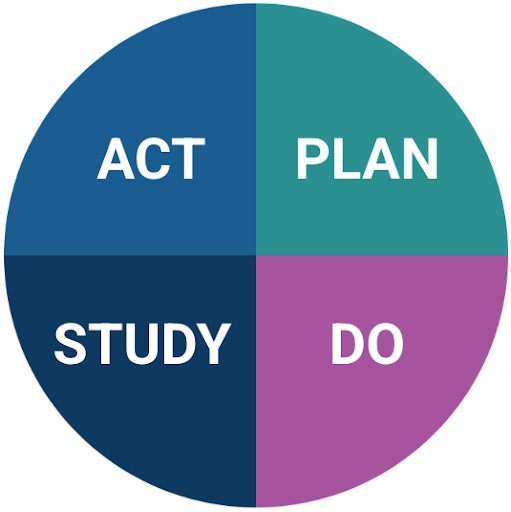
PDSA is not new. Our application is.
The Plan-Do-Study-Act cycle is commonly attributed to W. Edwards Deming (1986) and builds on earlier work by Walter Shewhart (1931/1980). Its premise is beautifully simple: rather than implementing something and assuming it works, organizations continually plan, test, study, and refine their practices.
In education, that mindset matters.
Contexts, systems, staff, and student needs are constantly evolving. As a result, even evidence-based interventions can yield varying outcomes depending on who receives them, who delivers them, the conditions surrounding implementation, and the specific root causes being targeted (Dimmitt et al., 2025; Zyromski & Dimmitt, 2022b).
Rather than relying on the single, superficial question (e.g., “Did we provide the intervention?”), a continuous improvement approach guides us through a far more meaningful set of questions:
1. What is happening, why, and what will we try?
2. Did we deliver it as intended?
3. What changed, for whom, and under what conditions?
4. Will we adopt, adapt, or abandon what we tried?
These core questions serve as the backbone of the PDSA process we use at Hatching Results.
From four phases to a practical roadmap
Traditional PDSA gives us four phases: Plan, Do, Study, Act. But when we began applying the process with school counselors, we found that practitioners needed more than four words around a circle. They needed a roadmap.
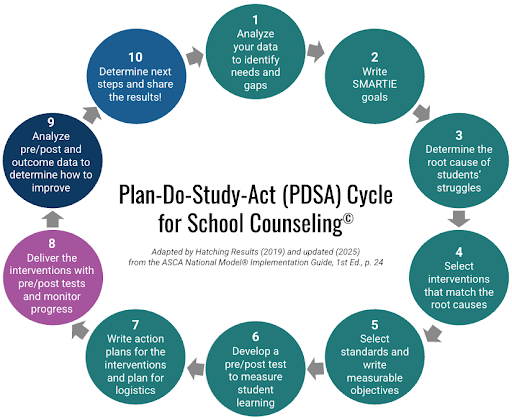
The Plan-Do-Study-Act Cycle for School Counseling© translates the four-phase PDSA improvement process into a 10-step roadmap for designing, implementing, evaluating, and improving student interventions.
Over years of training, consultation, implementation, and refinement, Hatching Results operationalized those four phases into a 10-step continuous improvement process specifically designed around the realities of student support.
PLAN: What is happening, why, and what will we try?
This is intentionally the largest part of the process. Before jumping to an intervention, teams:
Analyze data to identify needs and gaps.
Write a SMARTIE goal focused on how student outcomes should change.
Determine the root cause of students' struggles.
Select an intervention that actually matches that root cause.
Identify relevant standards or competencies and write measurable objectives.
Develop a pre/post assessment or another meaningful way to measure student learning.
Plan the intervention itself, including logistics, fidelity, collaborators, and evaluation.
There is a reason we spend so much time here.
Schools are often excellent at identifying symptoms: low grades, chronic absenteeism, behavioral referrals, incomplete financial aid applications, course failures.
However, addressing a symptom does not resolve the underlying root cause.
Two students can have the same failing grade for completely different reasons. One may not understand the content. Another understands it perfectly but is missing school because of transportation challenges. Another may complete assignments but never turn them in. Another may be experiencing depression. Another may be navigating a grading practice or school system that creates an unnecessary barrier.
Giving all five students the same intervention because they share the same outcome data is unlikely to produce equitable results. The goal is not to find the “magic intervention.”
The magic is in matching the intervention to the root cause.
DO: Did we deliver it as intended?
Eventually, we have to stop planning and try something.
During the Do phase, practitioners deliver the intervention, administer the planned pre/post measures, monitor progress, and pay close attention to implementation fidelity.
This distinction matters.
If an intervention does not produce the hoped-for outcome, we need to know whether the intervention itself was ineffective or whether students never really received what we intended to provide.
Was the six-session group actually six sessions?
Did the intended students participate?
Was instructional time protected?
Were essential components omitted because schedules changed?
Did the intervention need to be adapted midway through implementation?
These kinds of implementation data helps us interpret outcome data accurately.
STUDY: What changed, for whom, and under what conditions?
The Study stage is often the most critical, yet most frequently neglected, phase of continuous improvement. Moving beyond the simple question, “Did it work?”, teams must examine various types of evidence:
What changed in students' attitudes, knowledge, or skills?
What happened to the outcome that originally concerned us, such as attendance, grades, behavior, or college and career readiness?
For whom did the intervention appear to work? For whom did it not?
How strong was implementation fidelity?
What contextual or logistical factors helped or hindered success?
Ultimately, the central focus of this phase is answering:
What did we learn?
Analyzing results is not about validating adult performance, but about fostering greater success for students. This mindset shifts the data culture, transforming outcomes from critical judgment into actionable feedback.
ACT: Will we adopt, adapt, or abandon?
PDSA does not end with a data report. It ends with a decision. Based on what the team learned, there are three basic options:
Adopt. The intervention produced the intended results. Continue it, replicate it, and/or consider scaling it.
Adapt. While the intervention showed promise, it needs modifications before further testing.
Abandon. The intervention did not produce the desired results, even after reasonable adjustments. Stop investing precious time on something that is not working and test another approach.
Abandoning an intervention is not failure. Continuing an ineffective intervention indefinitely because “we've always done it” is a much greater problem. PDSA treats every cycle as an opportunity to learn.
One improvement process, two applications
Put PDSA into practice with your team.
Download our free PDSA Worksheet for School Counseling or PDSA Worksheet for Student Support Teams to guide your team from identifying a student need and investigating root causes through implementation, evaluation, and the decision to adopt, adapt, or abandon your intervention.
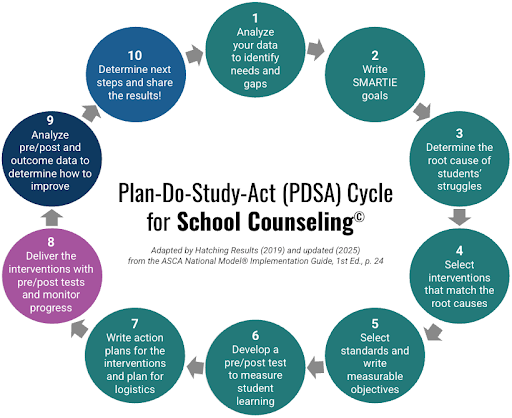
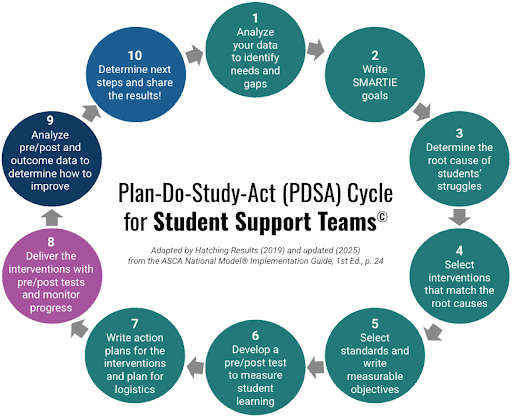
Our earliest work adapting PDSA for student support centered on comprehensive school counseling programs. That work ultimately became what we now call the Plan-Do-Study-Act Cycle for School Counseling©, including the 10-step framework featured throughout our newest book, Hatching Tier Two and Three Interventions in Your Secondary School Counseling Program (Triplett et al, 2026). The book itself is organized around helping practitioners design, implement, evaluate, and continually improve Tier 2 and Tier 3 supports.
But students do not experience support systems according to our professional titles.
A student struggling with attendance may simultaneously interact with a school counselor, social worker, administrator, attendance specialist, psychologist, teacher, family liaison, or community-based provider. When those professionals use different problem-solving processes, definitions of success, or intervention practices, even strong individual efforts can remain fragmented.
That is why we have also developed the Plan-Do-Study-Act Cycle for Student Support Teams©.
The underlying improvement process is intentionally the same. What changes is who is using it and how the work is organized.
Instead of PDSA living primarily within the comprehensive school counseling program, an interdisciplinary student support team can use the same shared process to identify needs, investigate root causes, coordinate interventions, examine fidelity and impact, and make decisions together.
This matters because collaboration is strongest when professionals do more than attend the same meetings. They need shared ways of thinking, shared decision-making processes, and shared definitions of success.
As we recently wrote about our evolution from silos toward more integrated student services, aligned systems make it less likely that students will fall through the cracks between well-intentioned professionals. PDSA can provide one piece of that infrastructure.
PDSA is a mindset, not another form to complete
It would be easy to turn PDSA into another compliance exercise. Fill out the worksheet. Check the boxes. Upload the data. Move on.
That misses the point.
At its core, PDSA requires humility. It asks educators to believe two things simultaneously:
We are doing the best we can with what we currently know.
And we can always learn how to do better.
That means being willing to discover that an intervention we love is not producing the impact we assumed. It means listening to students and families when their experiences challenge our assumptions. It means examining systems rather than automatically locating the problem within students. It means testing ideas without waiting until they are “perfect.” And it means changing course when the evidence tells us to.
In fact, while writing our newest Tier 2/3 book, our team realized that we had essentially used PDSA on PDSA itself. Years of implementation, training, feedback, testing, revision, and learning helped us strengthen the process before publishing this newest version.
That is continuous improvement.
Not perfection. Not one more initiative. A disciplined commitment to asking:
What are students telling us they need?
What will we try?
What happened?
What did we learn?
And what will we do better next time?
Because ultimately, the purpose of PDSA is not to complete a cycle. It is to build systems that continuously get better for students.
Ready to get started? Questions? Please reach out!
References:
Deming, W. E. (1986). Out of the crisis. Massachusetts Institute of Technology.
Dimmitt, C., Zyromski, B., Cholewa, B., Bledsoe, K. G., Henry, S., Kim, H., & Oehrtman, J. P. (2025). Evidence of success. ASCA School Counselor, 62(5), 10–15.
Shewhart, W. A. (1980). Economic control of quality of manufactured product. American Society for Quality Control. (Original work published 1931)
Triplett, W. D., Gomez, V. L., Duarte, D., & Hatch, T. (2026). Hatching tier two and three interventions in your secondary school counseling program. Corwin.
Zyromski, B., & Dimmitt, C. (2022b). Evidence-based school counseling: Embracing challenges/changes to the existing paradigm. Professional School Counseling, 26(1a), 1–10.
