Transforming Our Thinking About National School Counseling Week: Overcoming a Common Misconception
Editor's Note (2025): This blog post is adapted from an article originally written in January 2018 by Whitney Triplett, MA, LPC, NCC, with contributions from the Chicago Public Schools Master Counselors, Lisa De Gregorio, and Michele Howard. While the content remains unchanged, links and graphics have been updated to reflect current information.
School counselors (and others) sometimes view National School Counseling Week (NSCW) similarly to Teacher Appreciation Week1 - both as weeks designed to honor and celebrate educators. They see NSCW as simply a week to thank school counselors for the work that they do. It’s even common to hear the phrase, “Happy School Counselor Week” although it has intentionally been named “National School Counseling Week” to place emphasis on the school counseling program instead of the person. These views are not necessarily wrong, but they do miss the intention and spirit that are central to NSCW.
The American School Counselor Association (ASCA) states that NSCW, which is always the first full week of February annually, exists “to focus public attention on the unique contribution of school counselors within U.S. school systems.”2 Put another way, NSCW was designed to be a systemized opportunity for us to educate key stakeholders about school counseling. Quite simply, it is a vehicle for professional advocacy. While appreciation and celebration can certainly be a part of NSCW, they are not central to it.
The reality is that our profession still struggles with legitimacy.3 Many people, including our own colleagues, just don’t realize what it is we do on a daily basis, much less the impact that we are having on students. Many of our stakeholders still view us as “guidance counselors,” when, in reality, we have made exceptional strides to adapt our practice to that of transformed “school counselors.” For example, guidance counselors tend to provide reactive supports, whereas school counselors provide proactive, preventative supports. Guidance counselors tend to serve only a portion of their student population, whereas school counselors serve ALL students within a multi-tiered, multi-domain model (learn more!). Historically, there has been little accountability for guidance counselors, whereas school counselors regularly and systematically demonstrate their impact on key school metrics. Other key differences can be seen in the graphic below:
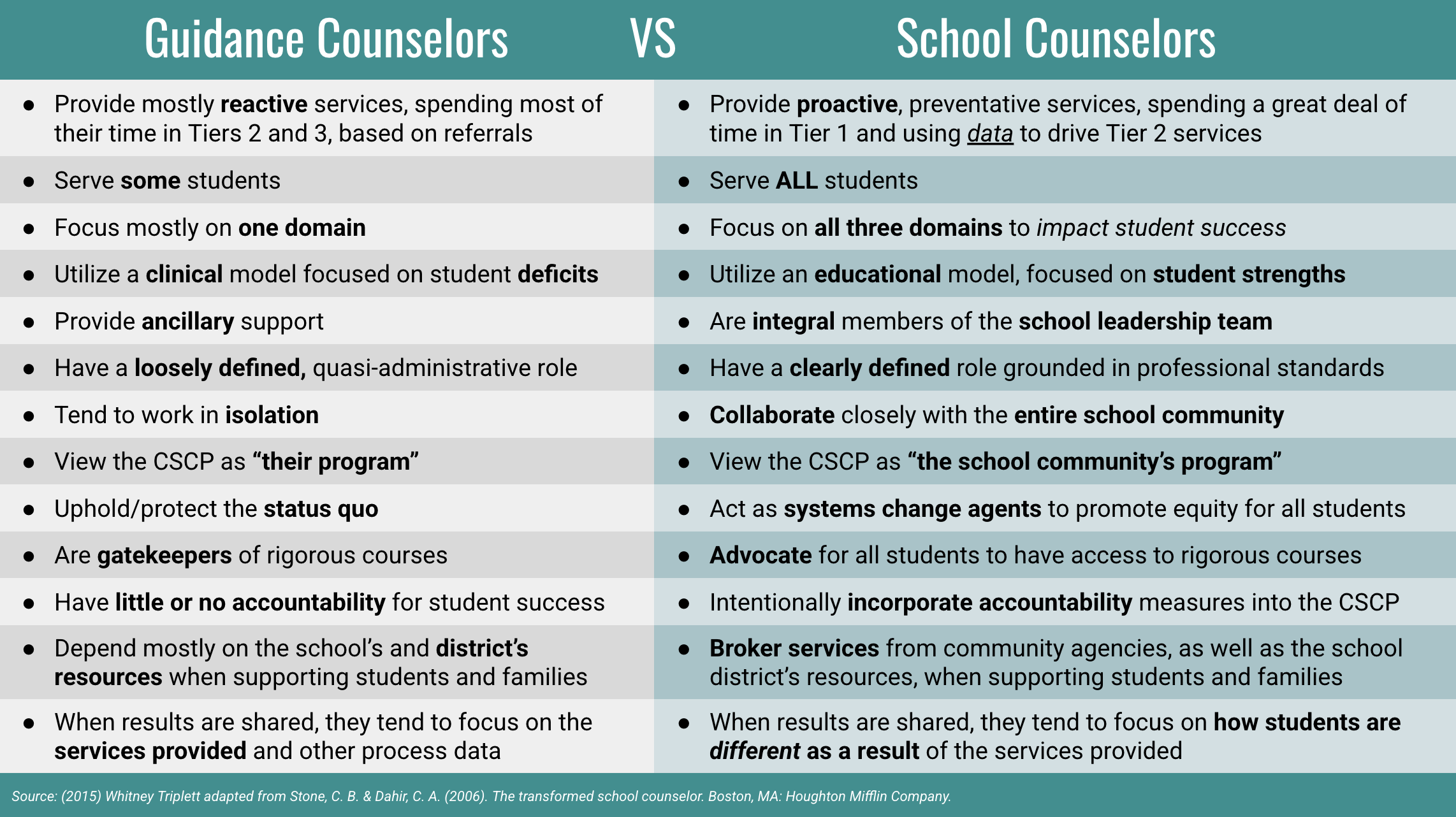
In order for school counselors to effectively support students, it is critical that stakeholders fully understand and buy into the breadth and depth of what it is that transformed school counselors do, including the impact that our actions have on our students. ASCA lists several ideas for promoting your school counseling program during NSCW. There are also tons of great ideas on school counseling blogs, websites, and even Pinterest. Here are a few to get your started:
Share the above “guidance counselor vs. school counselor” graphic with your principal and staff and discuss why it’s important that you operate as a “school counselor.”
Create a school counseling advisory council.
Create a catchy 1-page flyer or brochure about the impact of your comprehensive school counseling program on student success and leave in each teacher’s box with a piece of candy. You can also post it on the inside of the bathroom stall doors and hang above the water fountains.
Write a handwritten thank you note to your district’s superintendent and/or school board, thanking them for supporting the school counseling program. Print a copy of your flashlight presentation or data presentation to insert into the card (sample flashlight presentation | more samples - scroll down to Ch. 11).
Because we’ve chosen to be a part of a young, evolving profession, we also have a responsibility to contribute to the building of its legitimacy through advocacy for the betterment of our students. National School Counseling Week is a phenomenal opportunity for us to contribute to the legitimacy of our profession. It gives us a great excuse to pause, reflect on our own unique contribution, and then share it with our school community! In so doing, we build the capacity of our stakeholders to understand the role and function of a transformed school counselor that impacts student success. Greater understanding of the school counselor role will result in better supports for our students and a larger impact on student success.
Professional advocacy is not about school counselors--it’s about students. While we should absolutely celebrate and thank school counselors (#schoolcounselorsrock!) during NSCW, our primary focus should be on educating administrators, staff, students, families, and community partners about the role of today’s transformed school counselors in impacting student success. So let’s roll up our sleeves, put on our “advocate hats,” and utilize National School Counseling Week to be change agents for our profession!
1 https://www.pta.org/home/events/PTA-Teacher-Appreciation-Week
2 https://www.schoolcounselor.org/Events-Professional-Development/Events/National-School-Counseling-Week
3 Hatch, T. (2008). Professional challenges in school counseling: Organizational, institutional and political. Journal of School Counseling, 6(22). Retrieved January 9, 2018, from https://files.eric.ed.gov/fulltext/EJ894793.pdf