
What Happens When Student Services Stop Working in Silos?
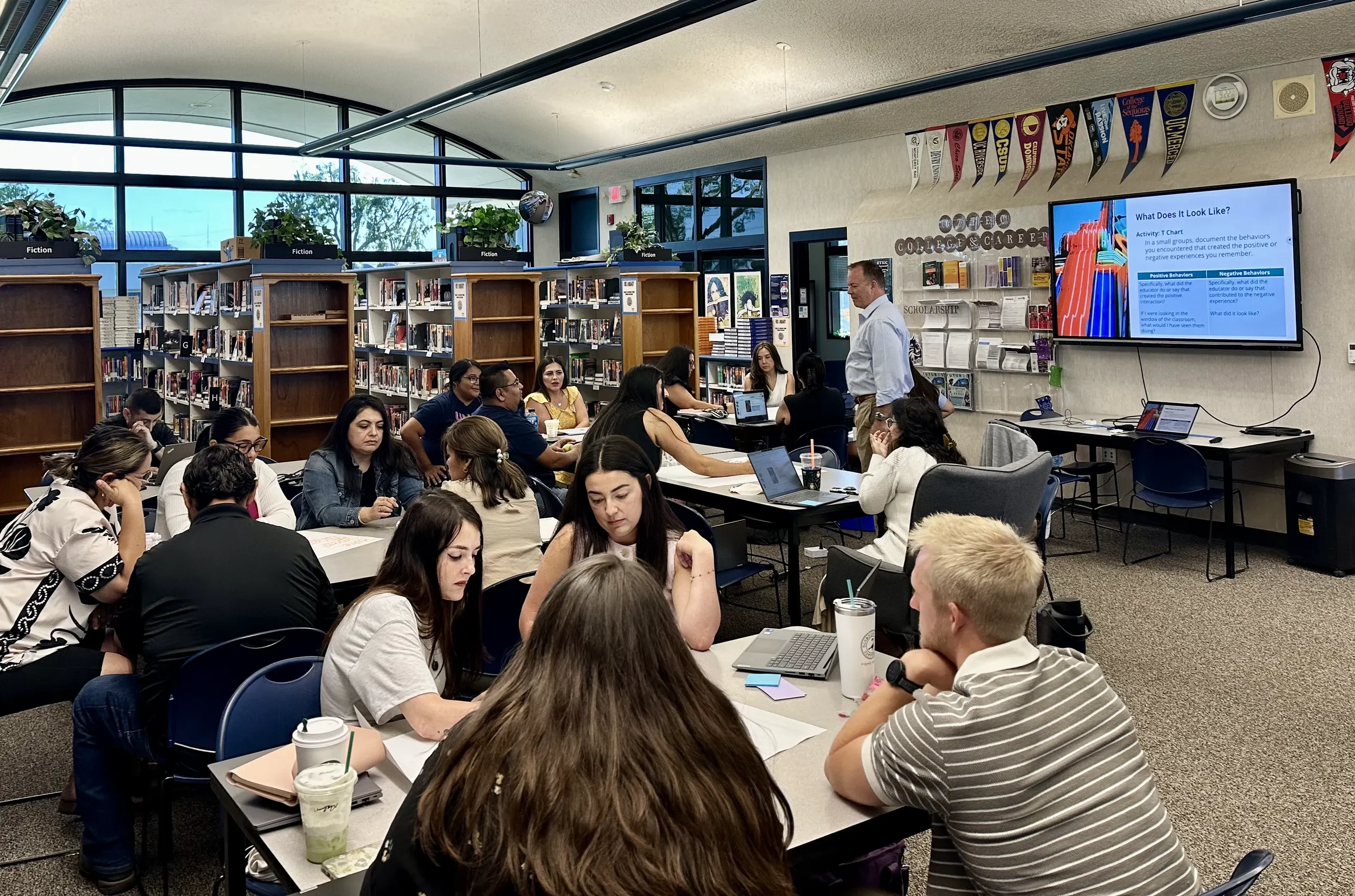
What happens when you put school counselors, school social workers, school psychologists, behavioral intervention specialists, CTE professionals, administrators, and district leaders in the same room and ask them to stop thinking first about their individual roles?
That’s part of what Farmersville Unified School District (CA) set out to discover this summer.
Farmersville USD serves approximately 2,600 students across six schools, from transitional kindergarten through 12th grade. About 93% of students are Hispanic, 85% qualify for free or reduced-price meals, and approximately 40% are English learners.
Like many districts, Farmersville USD has talented professionals supporting students. Those professionals come to work with different preparation, professional standards, responsibilities, and ways of thinking about student needs.
Farmersville wanted something more coherent.
Their goal wasn’t simply to bring everyone together for professional development. District leaders wanted to begin building one aligned system of student support across schools, roles, and grade levels. They wanted to design a system that could ultimately live in a Student Support Systems Handbook and endure beyond changes in individual practitioners or district leadership.

Start with people before building systems
Ahead of our July 2026 training, I met with Farmersville leaders several times to understand what they hoped would be different as a result of our partnership.
They wanted student services professionals to:
Build relationships across disciplines
Understand healthy student development
Clarify practitioner roles
Explore the difference between services that depend on individual people and those embedded within sustainable systems
So when we began the first of two days with the team, we didn’t start with MTSS.
We started with a person.
We asked everyone to think about an educator or another adult who had made a positive impact on their life.
The room quickly started buzzing. People told stories. They smiled and nodded as they listened. One person’s memory sparked another’s.
That was exactly the point.
Our experiences shape us. Relationships influence how young people understand themselves, navigate stress, and engage with the world around them. As Dr. Jack Shonkoff’s work at Harvard’s Center on the Developing Child has demonstrated, protective adult relationships can support children’s adaptive coping and sense of control.
Or, as one of our slides put it much more simply:
Relationships are a mental health intervention.
Next, teams identified the specific adult behaviors behind the positive (and negative) experiences they remembered. Not vague characteristics like “nice” or “supportive,” but observable behaviors:
What did that adult actually do?
What would we have seen if we were watching through the classroom window?
Then we flipped the activity forward:
If these are the experiences we know matter for young people, what do we want student support to look like, feel like, and sound like throughout Farmersville USD?
A reflection about relationships became the beginning of a shared vision for a system.
And that connection matters.
Systems should never replace relationships. Good systems make strong relationships more likely, more intentional, and more equitable.
From there, we introduced the concept of an Integrated Student Support Team.
Its objective sounds deceptively simple: improve outcomes for individual students and groups of students.
Doing that well requires teams to make deeper systems changes, strategically use practitioner time and expertise, and connect services that may currently operate separately.
That gets complicated quickly.
A school counselor may naturally organize student needs around academic, college/career, and social/emotional development.
A school psychologist may approach the same students through learning, psychoeducational assessment, mental health, behavior, culture, and home factors.
A school social worker brings another lens that may include school, home, community, culture, mental health, behavior, and social-emotional development.
None is wrong.
The overlap is the opportunity.
But when every professional starts with their standards and asks, “What am I supposed to do?”, schools can unintentionally create parallel systems organized around adults.
We challenged Farmersville’s teams to flip the question:
What do our students need and how can the collective expertise on this campus be organized to meet those needs?
That is a fundamentally different starting point.
It’s also why we spent time defining what we mean when we say we want to “improve student outcomes.” Ask two educators that question and you may hear achievement, attendance, behavior, mental health, graduation, postsecondary readiness, belonging…or something else entirely.
An integrated team needs a shared understanding of the outcomes it is trying to influence before it can make good decisions about roles, services, and resources.
We don’t need more heroes. We need stronger systems.
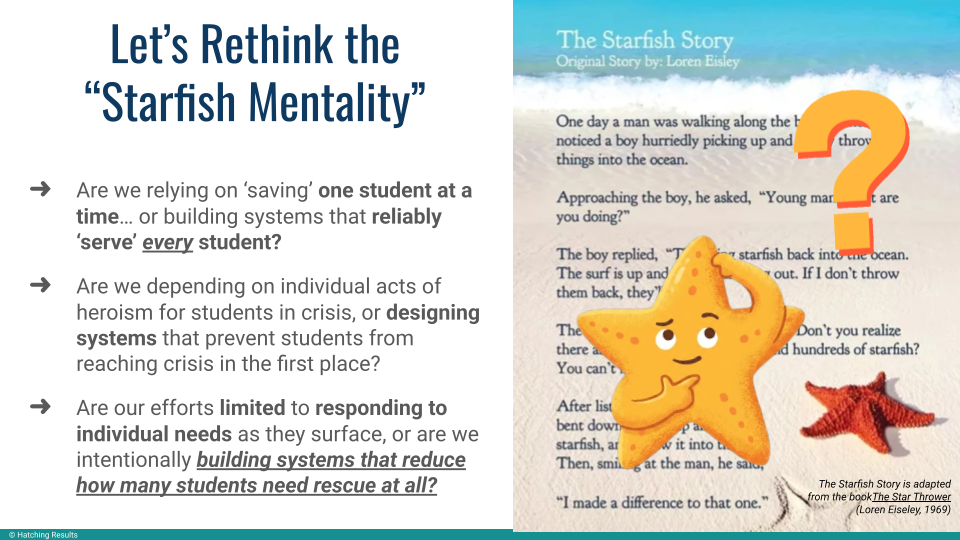
One of my favorite conversations from the two days came when we challenged the familiar Starfish Story.
Most educators know some version of it: thousands of starfish have washed onto a beach. Someone begins throwing them back one at a time. When told they can’t possibly save them all, they respond that their effort still matters to that one.
It’s a beautiful story about individual impact, and student services professionals live it every day.
A school counselor notices the student no one else noticed.
A school social worker finds a resource for a family in crisis.
A school psychologist stays late to call a parent.
Those moments absolutely matter.
But we asked the team to consider a different question:
Why are so many starfish washing up in the first place?
Are we depending on individual acts of heroism after students reach crisis, or designing systems that keep more students from reaching crisis?
Are we responding only when needs become visible, or examining patterns and changing the conditions producing them?
The message on the screen captured it:
Starfish moments matter. Systems determine how many starfish wash up. And you determine the systems.
That’s a significant mindset shift.
From person-dependent to program-centered
Many student support systems are heavily person-dependent:
A student receives help because the right adult notices.
A resource exists because one practitioner created it.
A process works because someone remembers all the steps.
A successful intervention disappears when the person who championed it changes positions.
That model can produce incredible individual stories. It can also create uneven access, role ambiguity, sustainability challenges, and difficulty determining whether services are actually improving outcomes.
Farmersville USD is working toward something different:
FROM: A collection of activities, referrals, and isolated supports
TO: A coordinated student support system aligned with student needs, school goals, and measurable outcomes.
And importantly, the goal isn’t more services. It’s more intentional services.
Look at what already exists before adding something new
We also introduced Farmersville teams to a Multi-Tiered, Multi-Domain System of Supports (MTMDSS), expanding the traditional tiered framework to include the full range of student development: college and career alongside academic, social/emotional, attendance, behavioral, and mental health needs.
Teams explored Tier 1, Tier 2, and Tier 3 while challenging some common assumptions.
For example, something being available to all students doesn’t necessarily make it Tier 1.
If students must opt in, sign up, ask for help, or know where to find a service, barriers may already be shaping who receives support.
True universal support requires us to ask:
What does every student deserve to receive and what systems will reduce barriers so every student actually receives it?
But we weren’t interested in handing Farmersville a generic menu of things they should be doing. They already do a lot.
Instead, each school completed an MTMDSS Landscape Scan of its current supports.
That becomes our starting point.
As our partnership continues, we’ll help the district examine those maps for strengths, gaps, duplication, inconsistencies, and opportunities for alignment. Ultimately, the work will contribute to a districtwide menu of interventions and a shared Student Support Systems Handbook that we are building together.
In other words, we aren’t starting by asking:
What else can we add?
We’re asking: How can we make what we already do more intentional, aligned, equitable, and effective?
One of the biggest success factors was already in the room
There was something else about these two days that I don’t want to overlook.
Leadership showed up. Literally.
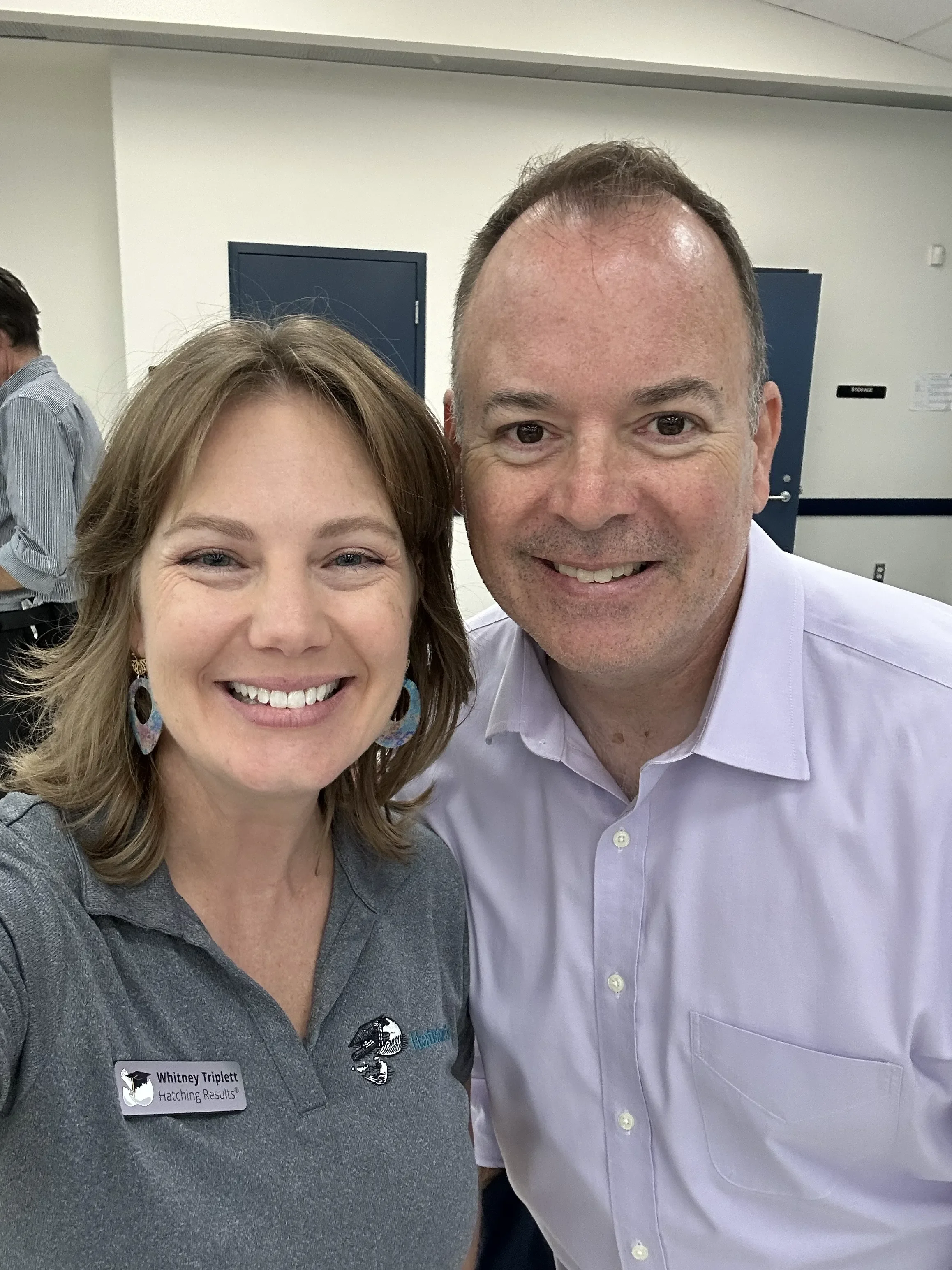
On our second day, site administrators joined their student services teams. District leaders were present throughout the work.
And Farmersville’s assistant superintendent didn’t simply introduce the training and leave.
He participated.
He listened. He moved from table to table. He sat with school teams as they examined their current systems. He asked about barriers. He helped clarify misunderstandings.
Most importantly, his presence communicated that this wasn’t “student services work” happening on the side of the district’s larger priorities.
This was district work.
That matters enormously.
If districts want practitioners to collaborate differently, redesign systems, clarify roles, use data differently, and hold one another accountable for student outcomes, leaders cannot outsource that change to the people sitting in the training.
They have to participate in it.
The practitioners showed up, too.
From the beginning, this group asked questions, offered perspectives, disagreed productively, and challenged one another. At one table, several school counselors – many brand-new to their positions – were already pushing one another’s thinking in thoughtful, professional ways.
That’s what healthy collaboration looks like.
Simply assembling a team doesn’t improve student outcomes. Strong teams examine evidence honestly, identify gaps, stay focused on students, and take shared responsibility for improvement.
This is just the beginning
Two days cannot build an integrated student support system, but they can build the foundation for one.
Our July work began a year-long partnership with Farmersville USD that includes additional professional learning, coaching and thought partnership, implementation assessment, and collaborative development of the district’s Student Support Systems Handbook.
That matters because sustainable systems aren’t created by attending a workshop and receiving templates.
They’re built through cycles of learning, implementation, reflection, refinement, and shared ownership.
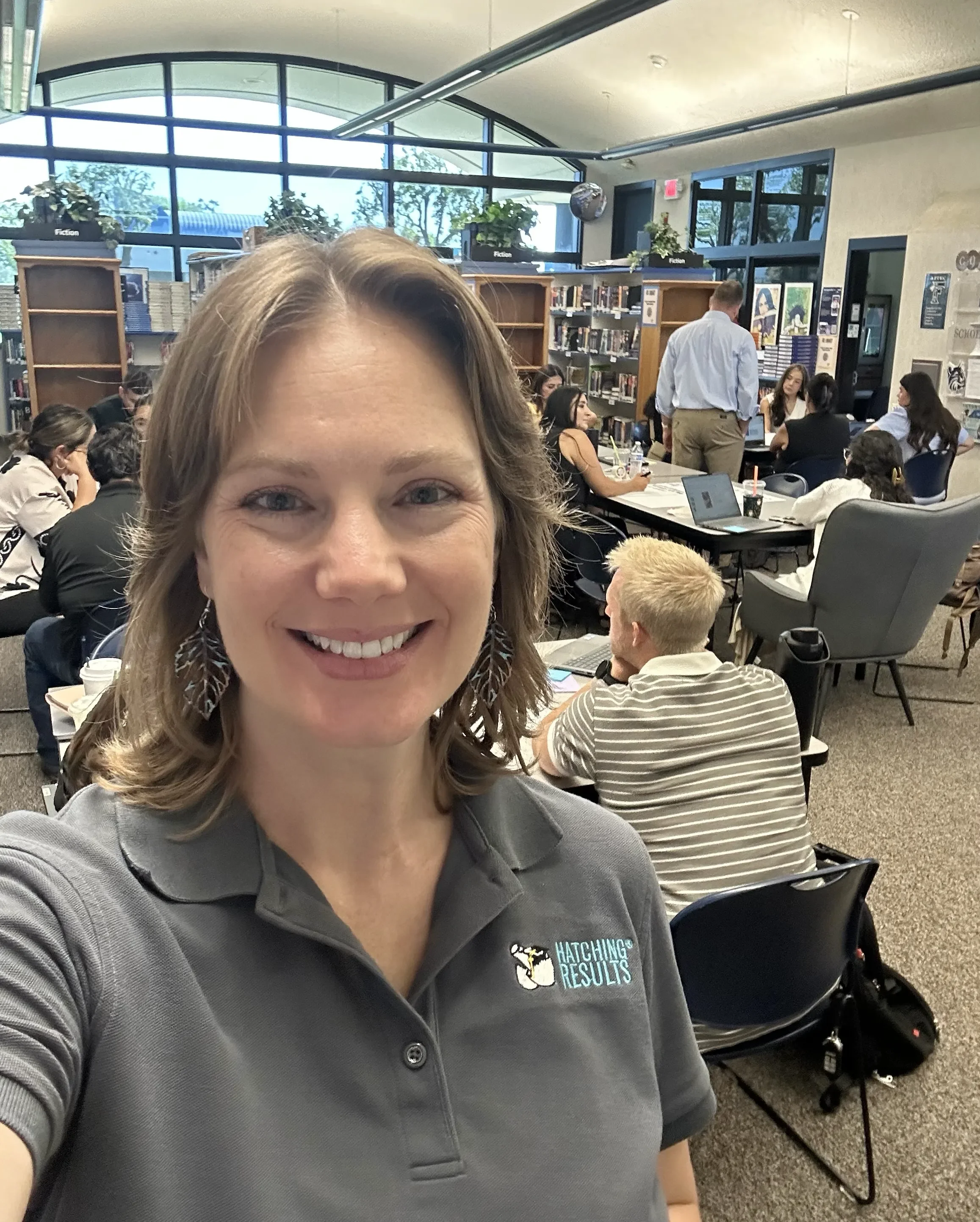
Farmersville USD has already taken one of the hardest steps: getting the right people in the room and giving them permission to think beyond their individual roles.
Now the work becomes turning shared vision into shared practice.
At Hatching Results, we’ve spent decades helping school counseling programs move from collections of activities toward comprehensive, data-driven systems. Increasingly, districts are asking us to help them take the next step:
How do we bring school counselors, school psychologists, school social workers, behavior professionals, administrators, and other student support professionals together into one coordinated system?
Farmersville is showing what a strong beginning can look like.
Start with students.
Honor the expertise each profession brings.
Build relationships.
Use data.
Examine the system.
Then organize the adults around what students need - not the other way around.
Because the goal isn’t just to have exceptional student support professionals. It’s to build an exceptional student support system.
Ready to strengthen and align your district’s student support system? Partner with Hatching Results, and let’s begin the conversation.
