
Strengthening the Heart of the School: A Strategic Case for School Counselor Collaboration and Alignment in Community Schools
Introduction: The Strategic Imperative of the CCSPP
The California Community Schools Partnership Program (CCSPP) represents a monumental $4.1 billion "whole-child" investment designed to transform student achievement across the state’s most underserved communities. With a funding sunset date of June 30, 2032, this initiative is not merely a temporary grant but a strategic effort to architect permanent, synergistic partnerships between school districts, families, and community providers.
The CCSPP defines a community school through four essential pillars:
Integrated Student Supports: Coordination of trauma-informed health, mental health, and social services, including early screening and intervention.
Family and Community Engagement: Culturally responsive partnerships and strengths-based collaboration.
Collaborative Leadership and Practices: Professional development focused on social-emotional learning, restorative justice, and transforming school culture.
Extended Learning Time and Opportunities: Enrichment and care beyond the standard instructional day.
However, to fulfill the promise of supporting all students effectively, districts must move beyond uncoordinated, reactive services toward a structured, systemic model. Moving from possibility to reality requires an intentional framework to ensure that the CCSPP does not become a series of isolated programs, but a cohesive strategy for long-term student success.
The School Counselor: The Cornerstone of Integrated Student Supports
Within the CCSPP framework, the school counselor is far more than a service provider; they are a systemic change agent and the "central nervous system" of school-linked supports. While the pillars of family engagement and collaborative leadership provide the structure, the school counselor provides the leadership required to operationalize these elements into a unified whole.
School counselors serve as the primary access point for student mental health and act as the frontline for Tier 1 universal prevention and Tier 2 targeted behavioral health support. Within the complex, whole-child ecosystem CCSPP, school counselors are the essential catalyst because they bridge the gap between systemic school structures, direct student needs, and external community resources.
How the school counselor’s role is vital to operationalizing the CCSPP model:
School counselors provide the operational framework for integrated support services using a Multi-Tiered, Multi-Domain System of Supports (MTMDSS)™ to address the academic, college/career, and social/emotional needs of students. While this framework organizes internal school supports, the CCSPP enhances it by allowing school counselors to seamlessly integrate critical community-based resources into these tiered interventions.
School counselors are the architects of "synergistic partnerships." The community school model relies on breaking down silos between educators, families, and outside agencies. School counselors are specifically trained to build synergistic partnerships with other student service providers, school staff, and community agencies. By establishing these collaborative networks, they ensure that every student receives the appropriate level of support according to their demonstrated need.
School counselors drive data-informed continuous improvement and equity. The CCSPP requires schools to utilize data to address learning barriers and continuously evaluate program impact. School counselors conduct regular, frequent analysis of aggregate and disaggregate student data—such as attendance, discipline, and achievement records—to identify root causes and decrease equity gaps. This ensures that CCSPP resources are deployed proactively based on documented student needs rather than just reacting to crises.
School counselors act as systemic change agents and "sustainability leads." Transforming a school into a successful community school requires a shift in adult mindsets and systemic practices. School counselors serve as systemic change agents who build sustainable internal leadership capacity at the school and district levels.
To lead effectively, school counselors must transition through the P3H mindset framework developed by Hatching Results:
Pilots: Empowered leaders who design, implement, and evaluate comprehensive, data-driven programs. They are the essential architects of student wellness.
Passengers: Willing but reactive participants who wait for direction rather than leading the initiative.
Prisoners: Staff members who feel trapped by new mandates and resist shifts in practice.
Hijackers: The most significant risk to CCSPP implementation. These individuals actively undermine systemic change, redirecting resources or sentiment away from the community school's mission.
Districts must empower school counselors to function as "Pilots." Without this proactive leadership, the "Integrated Support Services" pillar lacks the coordination necessary to ensure that interventions are targeted, measurable, and equitable. Hatching Results provides the specific MTMDSS framework needed to move school counselors into the pilot seat.
Operationalizing Excellence: Aligning Counseling Roles via MTMDSS
The Multi-Tiered, Multi-Domain System of Supports (MTMDSS)™ provides the operational architecture to align counseling roles with CCSPP’s mandate for early screening and intervention. By utilizing frameworks such as the ASCA National Model® and CASEL, districts can ensure that supports are organized by student need rather than administrative convenience.
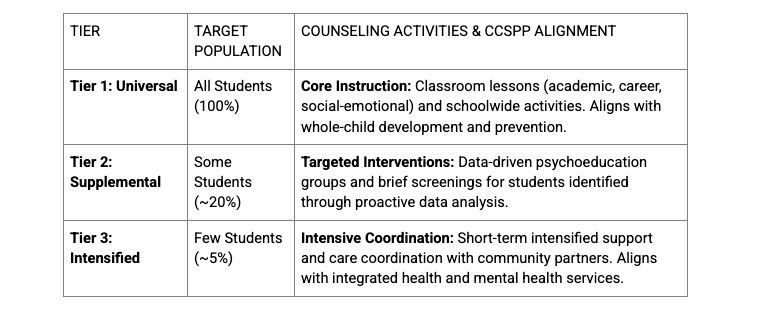
With a structured MTMDSS framework in place, districts can effectively implement a student needs approach to the Children and Youth Behavioral Health Initiative (CYBHI). Operationalizing this model is critical given the current implementation of the CYBHI Fee Schedule administered by DHCS. By successfully blending and braiding these funds—such as using a CCSPP implementation grant to build a multi-tiered support system and then using CYBHI reimbursements to permanently fund the staff operating that system—districts can turn school counselors into "sustainability leads" who generate revenue to secure their own positions and support student wellness. Hatching Results trains districts to lead with an ethical, student-centered approach where data drives the intervention, ensuring that billable services like psychoeducation and care coordination are delivered based on documented student needs.
Navigating Fiscal Compliance: The "Supplement, Not Supplant" Mandate
Fiscal integrity is vital. All CCSPP funds must be supplemental—expanding or establishing programs rather than replacing existing district obligations. To stay within budget rules, districts should fund new school counselor roles under Certificated Salaries (Code 1000). Additionally, districts must adhere to the 33% Match Rule by documenting a 33% local match annually, including in-kind contributions.
Hatching Results can help schools mitigate audit risks by ensuring expenditures align with the Needs and Assets Assessment (NAA)—also frequently referred to as Community Asset Mapping and Needs/Gap Analysis—that is used to guide school improvement and resource allocation.
Training Student Support Staff: Allowable Professional Development
The CCSPP grant guidelines provide a broad range of allowable professional development (PD) and training topics aligned to the work of school counselors. Specifically, the following CCSPP-funded PD areas directly overlap with a school counselor's role:
Integrated Student Supports and MTSS: The CCSPP explicitly funds PD to help student support staff implement coordinated support strategies, such as a Multi-Tiered System of Supports (MTSS) or a Coordination of Services Team (COST). Additionally, school counselors utilize a Multi-Tiered, Multi-Domain System of Supports (MTMDSS) to proactively organize their services across three tiers (universal, supplemental, and intensified) and three domains (academic, college/career, and social/emotional).
Positive Behavioral Interventions and Trauma-Informed Care: CCSPP allows funding for PD on trauma-informed instructional approaches, restorative practices, and positive behavioral interventions.
Collaborative Planning and Teaming: The CCSPP grant covers training and planning meetings that specifically bring together school counselors, school-based mental health professionals, teachers, community-based mental health professionals, and community organizations. A key function of these diverse practitioners is to build "synergistic partnerships" with other student service providers and community agencies to ensure all students receive the right level of support, making collaborative PD highly relevant.
Data-Driven Needs Assessment: CCSPP funds PD and planning time to "discover, review, plan, and address student needs," particularly regarding learning loss. This aligns perfectly with a school counselor's responsibility to conduct regular, frequent analysis of student data—such as attendance, discipline, and achievement records—to identify equity gaps, find root causes, and select students for Tier 2 targeted interventions.
Family and Community Engagement: Grant funds can be used for PD on developing trusting, inclusive, and culturally responsive relationships with families. Because school counselors must collaborate with families to resolve barriers to learning and coordinate intensified Tier 3 supports, training in family engagement is highly applicable to their practice.
Measuring What Matters: Data as the Catalyst for Sustainability
Data collection is the "political social capital" required to sustain community schools beyond the 2032 sunset date. To survive the transition from grant funding to general fund integration, school counseling programs must move from documenting "activities" to proving "results."
Districts leveraging Hatching Results tools can answer the critical question: "Is the program making a difference?" through:
Implementation Fidelity Inventory (IFI)™: A proprietary tool to measure how fully the district is implementing a comprehensive, data-driven student support program within a tiered system of supports.
School Counseling Perceptions Survey™: Assessing shifts in school climate and the effectiveness of integrated supports.
Conceptual Framework™:Hatching Results is a national leader in outcome data analysis, using data-driven practices to track achievement, discipline, and attendance to ensure there is no disproportionality in student success.
Documenting these outcomes builds the institutional legitimacy needed to secure board support and long-term funding. Without measurable proof of impact, these vital initiatives are at high risk of disappearing once the state grant ends.
Conclusion: Partnering for Transformational Change
Strengthening the heart of the school requires more than a financial investment; it requires a structural shift in how districts architect student wellness. The CCSPP offers a once-in-a-generation opportunity to eliminate opportunity gaps. We invite district leaders to move from possibility to reality by leveraging our expertise in building sustainable leadership capacity, ensuring that every student in every community school is supported by a comprehensive, data-driven program.
Want to learn more about how Hatching Results supports aligned student services systems? Click here!!
